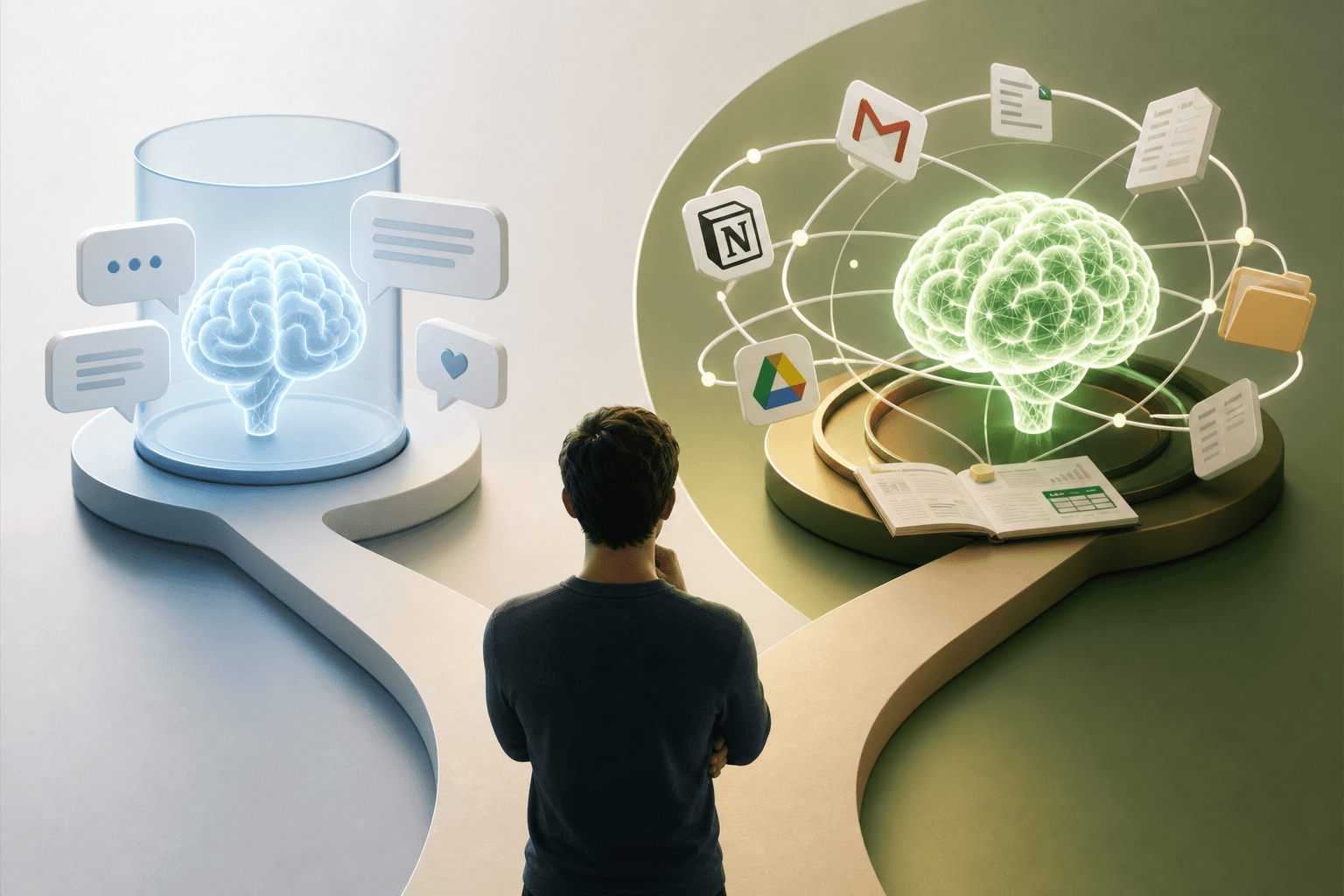
Claude now has substantially more memory than a stateless chat window. It can search past conversations, build topic-based memory from chats, and keep separate memory inside projects. Claude can also reach external work through first-party and remote MCP connectors. The useful comparison is therefore not whether Claude remembers anything. It is where that memory lives, which sources it represents, and whether the same organized context can travel to another AI client.
What Claude Memory does today
Claude can search eligible past chats and cite the conversations it used. With memory enabled, it stores information as individual topics, lets a user review or edit those topics, and carries them into later chats and supported Cowork tasks.
Projects have separate memory spaces and project summaries. That gives Claude a real scoping model: a project can retain its own conversational context without mixing it into unrelated project or non-project chats.
Claude memory is therefore not an opaque pool with no organization or review. It has user-visible topics, project boundaries, incognito chats, deletion controls, and citations when past-chat search is used.
Sources:[1]
Memory and connectors solve different parts of the problem
Claude's native memory is generated from activity inside Claude. Connectors are the separate path for live external information. Anthropic currently documents Google Workspace connectors for Gmail, Calendar, and Drive, including links back to source material where available.
Claude also supports remote MCP connectors on Free, Pro, Max, Team, and Enterprise plans, subject to plan and administrator controls. A connector can make an external system available in a conversation, but connecting a source is not the same thing as maintaining one portable, structured memory model across multiple AI providers.
That distinction matters when comparing products. Claude can work with external data directly; hippocampOS is not the only way to bring work context into Claude. The difference is the memory boundary and whether the organized context remains available outside Claude as well.
Claude memory preserves continuity inside Claude. hippocampOS adds a source-linked memory layer that can be deliberately reused across supported AI clients.
What hippocampOS adds
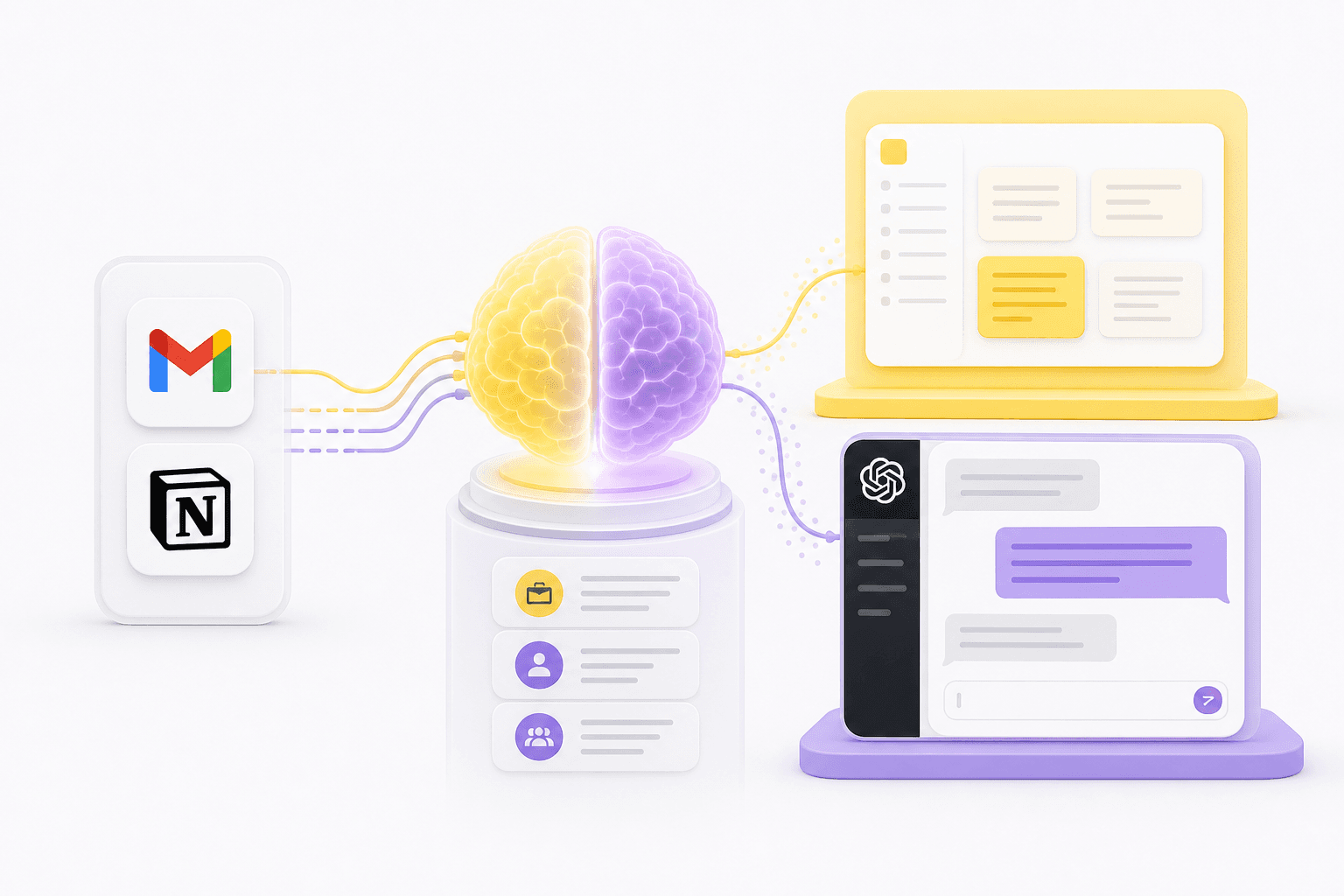
hippocampOS connects authorized work sources, including supported email, notes, meetings, and files, and turns them into source-linked memory. Named brains provide explicit boundaries for a role, project, client, or area of life.
A supported AI client retrieves a bounded slice from the selected brain instead of receiving an unscoped archive. The same brain can be used from supported Claude, ChatGPT, Claude Code, and compatible MCP connections, so the organizational layer is not owned by one chat provider.
The public MCP surface is intentionally read-only. That is a different tradeoff from connectors that can edit an external workspace: hippocampOS focuses on scoped retrieval and provenance rather than making an AI client an administrator of the memory store.
Side-by-side comparison
Claude's native memory, Claude connectors, and hippocampOS can complement one another. They operate at different layers, so the best choice depends on whether you need conversational continuity, live source access, or a portable memory structure.
Comparison table
Swipe horizontally to see every column.
| Tool | Best for | Client reach | Pricing | Key limitation |
|---|---|---|---|---|
| Claude Memory | Low-friction continuity across Claude chats and project work | Claude only | Included on eligible Claude plans | Its native memory remains inside the Claude account and project model |
| Claude connectors | Using live external tools and documents inside Claude | Claude only | Availability depends on connector, plan, and workspace controls | A connector is source access, not a shared memory layer across providers |
| hippocampOS | Source-linked, role-scoped context reused across supported AI clients | Claude, ChatGPT, Claude Code, and compatible MCP clients | Spark starts at $5/mo when billed annually; 7-day refund guarantee | Requires source setup and has an expanding connector set |
When Claude's built-in options are enough
Claude memory is the simplest choice when most of your work already happens in Claude and the context you need comes from previous chats. It has no separate memory product to configure, and project memory provides useful separation for many individual workflows.
Claude's own connectors may also be enough when the requirement is to search or act on a supported source during a conversation. Gmail and Drive users, for example, can bring live information into Claude without first copying it into another system.
If you do not need the same organized context in ChatGPT or another client, adding a separate cross-client layer may create more setup than value.
When a separate memory layer earns its place
A separate layer becomes more useful when your context spans several source systems, you regularly switch AI clients, or you want durable role and project boundaries that are independent of any one provider's chat history.
Source provenance is another reason. hippocampOS is designed to retain the path from a retrieved fact back to supporting material, making important context easier to inspect and correct.
The practical approach is often to use both layers. Let Claude remember how you work inside Claude, and invoke a hippocampOS brain when the task needs scoped context assembled from connected work sources.
Sources
- Anthropic: Use Claude's chat search and memory to build on previous contextAccessed 2026-09-15
- Anthropic: Use Google Workspace connectorsAccessed 2026-09-15
- Anthropic: Get started with custom connectors using remote MCPAccessed 2026-09-15
- hippocampOS: Connection instructionsAccessed 2026-09-15
- hippocampOS: PlansAccessed 2026-09-15
- hippocampOS: Privacy StatementAccessed 2026-09-15
Frequently asked questions
Does hippocampOS replace Claude Memory?
No. Claude Memory carries context from Claude chats and keeps separate project memory. hippocampOS supplies source-linked context from an intentionally selected brain. They can work together in the same conversation.
Can Claude access Gmail without hippocampOS?
Yes. Anthropic documents Google Workspace connectors for Gmail, Calendar, and Drive. hippocampOS differs by organizing supported sources into named, source-linked brains that can also be used from other supported AI clients.
Can Claude users inspect what its native memory contains?
Yes. Claude exposes memory topics in Settings, lets users edit or delete them, and maintains separate memory for projects. Past-chat search can also cite the conversations it used.
Can one hippocampOS brain work with both Claude and ChatGPT?
Yes, through supported connections. The brain remains the selected memory scope while Claude, ChatGPT, Claude Code, or another compatible MCP client retrieves relevant context.
Which option is better for a Claude-only workflow?
Start with Claude Memory and Claude's own connectors. Add a separate memory layer when you need cross-client portability, source-linked facts, or boundaries that should remain independent of the Claude account and project model.