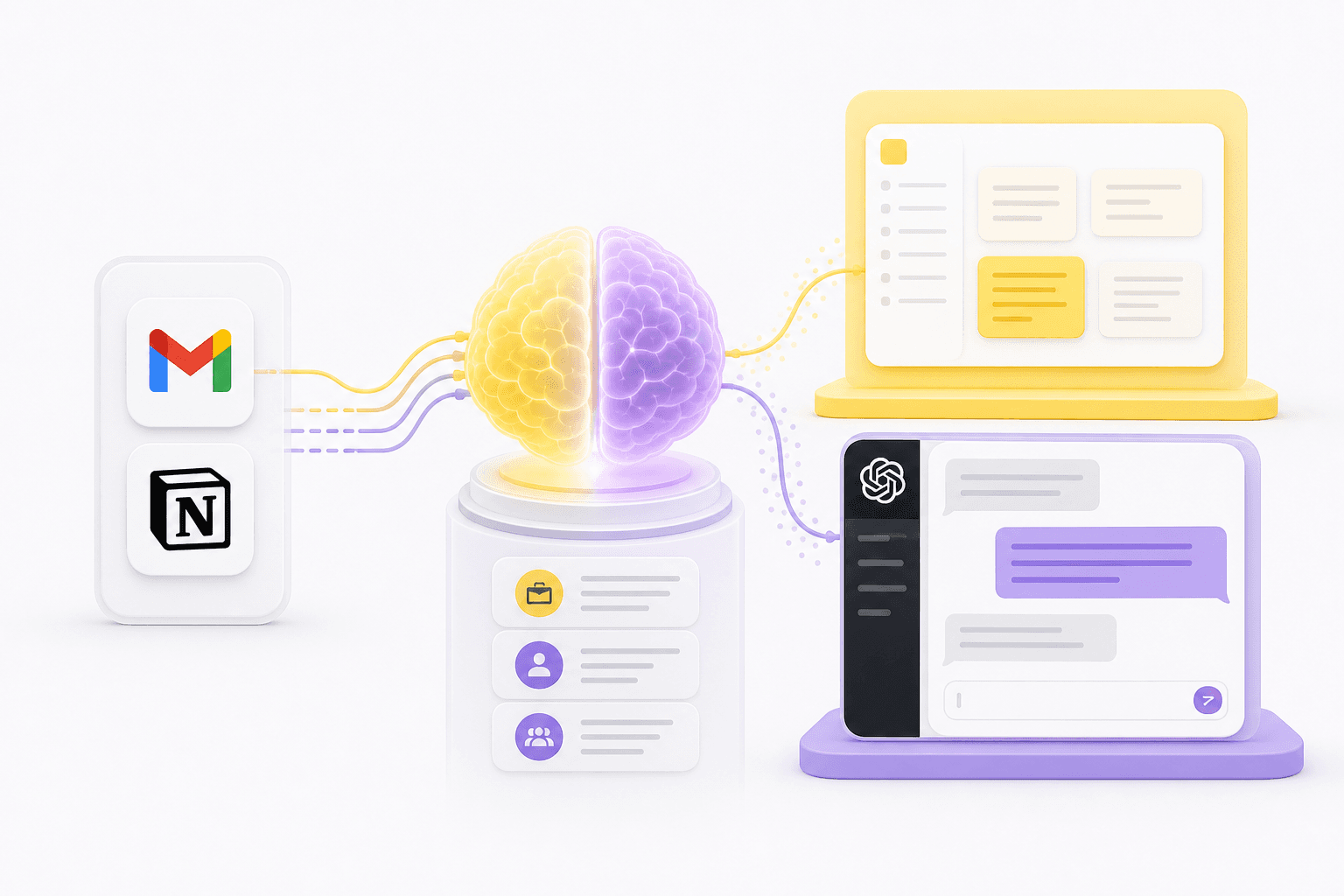
A useful Mem alternative should be evaluated against what Mem actually offers today. Mem is no longer limited to a separate notes interface: its hosted MCP server lets Claude, ChatGPT, Claude Code, Codex CLI, and Gemini CLI work with Mem notes and collections. The remaining choice is about the shape of memory you want: a writable notes workspace, a source-linked knowledge layer, developer infrastructure, a Notion-centered workspace, or native memory inside each AI provider.
Use Mem's current product as the baseline
Mem MCP gives supported AI clients secure access to notes and collections. Its documented tool surface can create, search, read, update, organize, trash, and restore content. Mem can therefore work directly inside authorized Claude and ChatGPT conversations.
Mem remains centered on its own knowledge model: notes, attachments, recordings, and collections. Context must first reach that workspace through capture, import, a connection, or an AI client writing through MCP.
For people who want an AI-native notes workspace that external assistants can both read and edit, this is a strength. People comparing alternatives should ask whether they instead want automatic source ingestion, read-only retrieval, stricter role scopes, or an API they can build into their own product.
Five approaches to persistent memory
These products overlap, but they are not interchangeable. The useful comparison is the ownership of the memory, the route by which context enters it, the clients that can use it, and the permissions those clients receive.
hippocampOS
hippocampOS connects supported work sources and organizes the resulting context into named brains. A brain is an intentional boundary for a role, project, client, or area of life, with retrieved facts linked back to supporting source material.
Supported Claude, ChatGPT, Claude Code, and compatible MCP connections retrieve context from the selected brain through a read-only public tool surface. That makes hippocampOS a fit for people who value source provenance and cross-client retrieval more than having the AI rewrite their memory store.
Mem0
Mem0 is developer memory infrastructure for agents and applications. Its hosted plans currently include a free Hobby tier, a $19 Starter tier, and a $249 Pro tier; hosted graph memory is listed on Pro. Mem0 also publishes an open-source graph memory implementation.
This is the strongest fit when an engineering team wants to control how an application writes, retrieves, and reasons over memory. It is not the same self-serve workflow as connecting a personal knowledge product to Claude or ChatGPT.
Notion MCP
Notion MCP connects Claude, ChatGPT, Cursor, and other compatible clients directly to a Notion workspace. It can read from and write to pages in real time while respecting existing Notion permissions.
That makes it compelling when Notion is already the system of record. The tradeoff is scope: Notion warns that MCP tools act with the connecting user's full Notion permissions, so teams should review workspace and administrator controls carefully.
Sources:[6]
Native Claude and ChatGPT memory
Claude and ChatGPT both maintain native memory under their own account, plan, and workspace controls. Claude stores topic-based memories from chats and has separate project memory. ChatGPT's current memory can use context from chats, files, and connected apps, depending on availability and settings.
Native memory is the lowest-friction option for people who live in one AI product. It does not create one shared memory model that automatically moves between providers.
The strongest alternative is not the tool with the longest feature list. It is the memory model that matches where your context lives and how you want AI clients to use it.
Feature comparison
The table focuses on durable differences rather than declaring one universal winner. Plan limits and connector availability can change, so verify the current vendor pages for a purchasing decision.
Comparison table
Swipe horizontally to see every column.
| Tool | Best for | Client reach | Pricing | Key limitation |
|---|---|---|---|---|
| Mem | A writable AI-native notes and collections workspace | Claude, ChatGPT, Claude Code, Codex CLI, and Gemini CLI through MCP | Free and paid workspace plans; verify current limits | External context must first become content in the Mem workspace |
| hippocampOS | Source-linked, role-scoped context for knowledge workers | Claude, ChatGPT, Claude Code, and compatible MCP clients | Spark starts at $5/mo when billed annually; 7-day refund guarantee | Read-only AI retrieval and an expanding connector set |
| Mem0 | Developers building memory into agents and applications | Any client an engineering team integrates | Free Hobby, $19 Starter, $249 Pro with hosted graph memory | Requires product or workflow integration |
| Notion MCP | People whose durable knowledge already lives in Notion | Claude, ChatGPT, Cursor, and compatible MCP clients | Depends on Notion plan and AI-client access | The connection acts with the user's Notion permissions |
| Native AI memory | People who primarily use one AI provider | Inside the provider that owns the memory | Included with eligible provider plans | Memory does not automatically transfer between providers |
How to choose without buying the wrong architecture
Choose Mem when you want a notes and collections workspace that an AI client can read and write. Choose Mem0 when you are building the memory behavior into your own agent or application. Choose Notion MCP when Notion is already your knowledge system and its permission model fits the workflow.
Start with native memory when one AI provider contains most of your work and conversational continuity is the main requirement. Choose hippocampOS when supported work sources should become one source-linked, role-scoped layer that you can intentionally retrieve from more than one AI client.
Before committing, test the real workflow: connect one representative source, retrieve a recent decision, inspect its provenance, switch AI clients, and revoke access. That reveals more than a feature checklist.
Sources
- Mem: Mem MCP overviewAccessed 2026-09-15
- Mem: Mem MCP setupAccessed 2026-09-15
- Mem: Mem MCP supported toolsAccessed 2026-09-15
- Mem0: AI memory pricingAccessed 2026-09-15
- Mem0: Graph Memory documentationAccessed 2026-09-15
- Notion: Connect AI tools with Notion MCPAccessed 2026-09-15
- Anthropic: Use Claude's chat search and memory to build on previous contextAccessed 2026-09-15
- OpenAI: Memory FAQAccessed 2026-09-15
- hippocampOS: Connection instructionsAccessed 2026-09-15
- hippocampOS: PlansAccessed 2026-09-15
- hippocampOS: Privacy StatementAccessed 2026-09-15
Frequently asked questions
Does Mem work with Claude and ChatGPT?
Yes. Mem's official MCP documentation lists Claude, ChatGPT, Claude Code, Codex CLI, and Gemini CLI. Those clients can work with Mem notes and collections after the user connects and authorizes the hosted MCP server.
What is the main difference between Mem and hippocampOS?
Mem centers on a writable workspace of notes and collections. hippocampOS centers on read-only retrieval from named, source-linked brains built from supported work sources. Both can make context available to Claude and ChatGPT.
Is Mem0 an end-user alternative to Mem?
Mem0 is primarily infrastructure for developers building memory into agents and applications. Individuals can use its hosted or open-source tools, but doing so requires more integration work than connecting a self-serve knowledge product.
Can Notion MCP provide context to both Claude and ChatGPT?
Yes. Notion documents support for Claude, ChatGPT, Cursor, and compatible MCP clients. The connection respects Notion permissions and can read from or write to pages based on the tools and access granted.
Do Claude and ChatGPT share their native memory?
No. Each provider manages native memory inside its own account and workspace model. A third-party knowledge or memory layer is required when the same organized context should be available through both providers.
Which option preserves source provenance?
hippocampOS is designed around facts linked to supporting source material. Other tools expose links or citations in particular workflows, so verify the exact connector and retrieval path that matters to you.